TechTok #15. It's never too soon: Find out how to plan your digital afterlife
Life is full of wonderful moments that make it worth living — watching a beautiful sunrise, witnessing your child taking their first steps, spending a quiet evening together with your family. But, sadly, there is the other side to life, less joyful but inevitable. Eventually we all have to face our own mortality, and everyone chooses for themselves how to deal with it. Many people find solace and inner peace in writing a will and keeping it updated, knowing that their belongings will end up in good hands, that their fortune will pass on to their children and other loved ones, or maybe going to charities to support a good cause.
This is the way of life, this is how we as humanity believe things should be. You write a will, and when you are no more, everything you leave after yourself goes where you intended. But what was clear and relatively straightforward throughout most of human history gets a little blurred when we start talking about digital legacy.
Over our lives, we accumulate an insane number of digital assets, things that hold either tangible or sentimental value. From those that are easier to evaluate like cryptocurrencies, domain names, online businesses, and various libraries like Netflix and Steam, to more ephemeral ones like photos and videos in cloud storage, social media and email accounts. Yes, you don’t have to do anything with any of these or think about it at all. But if you care about your physical legacy, why wouldn’t you treat the digital one the same way?
Imagine that you have two houses, but only leave to your kids the keys to one of them, and the other one you don’t as much as mention in your will. The house will stand there growing moss, all the while the rent keeps running the same way your accounts will keep getting charged for subscriptions if left unattended. And with the huge scale of our online presence, this analogy is not as outrageous as it may sound at first. In fact, it might be even messier than that — because unlike that second house, your digital assets don’t just sit still. They can be stolen, cloned, mined for data, or turned into an AI version of you without anyone asking for permission.
We trust that you can sort out the physical side of your will without our help. But how do you actually make sure that everything will be in order with the digital part of your life after you pass away? Before we start giving actionable advice, let’s go over what requires our attention and why.
- Tangible assets. Cryptocurrencies, domain names, subscription libraries. This is the category that is the closest to the traditional, physical inheritance. You want to ensure that your intended heirs will be able to benefit from your digital assets, but figuring out the best way to ensure it may not be so clear-cut.
- Things that hold sentimental value. This is where things start to get blurry. You can’t put a price tag on the photos you store in your cloud storage, but your friends and family members still probably wouldn’t want them to get lost forever.
- Your image and identity. How will people remember you? What will they think about you, if at all? Even the most cynical of us probably wouldn’t want someone to hijack their persona to carry out scams and other shady schemes.
Sometimes, a certain thing doesn’t fall firmly into this or that bucket. For example, your Google account can be key to access your crypto wallet backup, contain photos of your children, and also store years and years of emails with your unique voice and opinions — you can make an argument for it to belong to any of the categories we outlined, or to all three at once. Whenever this happens, we will try to be as clear and precise in wording as possible to avoid any confusion. We also included a separate actionable ‘cheat sheet’ at the end of the article, so if you decide to clean up your digital life, you can refer to it instead of scrolling back and forth, trying to tie together several different pieces of advice.
Chapter 1: Tangible things
When it comes to the post-mortem management of your digital assets, there are two major risks: that they fall into the wrong hands and that the intended recipients can’t access them. Luckily, both of these problems usually can be solved simultaneously by the same precautions.
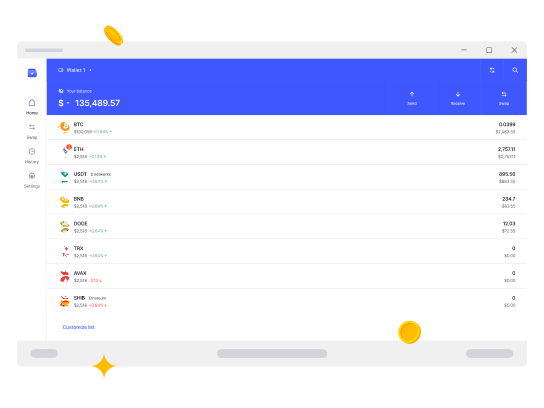
The most obvious asset from this category is, of course, cryptocurrency. Its defining feature is that because of how seed phrases work, crypto is one of the few assets that can be permanently lost and instantly stolen. If you have any, and nowadays many do, the tricky part is making sure the intended person gets access to it after your passing, but not creating a vulnerability in the process. There are a few ways to do that.
You could create a multi-signature wallet that requires 2 or 3 keys to authorize a transaction. You hold one key, another one can be stored somewhere safe like a bank safe deposit box, the third one can be placed with someone trusted, for example. This way, no single person can feasibly steal your funds while you are alive, but it is relatively easy for your heirs to combine the keys after your death. Another similar method is called the Shamir’s secret sharing scheme, in which a seed phrase is divided into several fragments that are distributed among trusted people. A certain threshold of fragments is required to reconstruct the phrase, so this scheme greatly reduces the risk of losing your funds while making it easy for the future heirs to obtain them. There are other ways, but most of them involve splitting the seed phrase into parts one way or another, or otherwise ensuring that no single person or entity holds keys to your crypto. Whatever you do, do not put everything in one place and never put your private keys and seed phrases directly in your will — wills can become public documents, and crypto and publicity do not go very well together.
Besides security issues, there is also a legal angle. While you should never include your seed phrases, PINs, or passwords into your will, you should identify the assets and name beneficiaries there. Use a separate, non-public letter with instructions on how to access the keys. Remember that the person or persons who you leave your crypto assets to may not be technically fluent and may need a plain-language document that explains everything there is to know in an easy-to-understand way.
You may ask, why couldn’t you just skip a step, omit the crypto assets from your will, and do everything ‘quietly.’ You could, and many people do just that, but this is technically illegal. The blockchain doesn’t care who the person doing the transactions is, as long as they have the necessary keys. But sidestepping all the legal processes is potentially fraught with many problems for the beneficiary if there is any debt involved or if there are relatives who want to dispute the will, not to mention that this is straight-up tax fraud. In practice, if the amount of crypto that you leave is small, the ‘quiet’ way may work (which doesn’t make it any more legal), but by omitting any substantial crypto funds from the will you are likely only doing a disservice to the future heir, who will be the one dealing with all the potential aftermath.
We dedicated a lot to cryptocurrency because it is, perhaps, the most common digital asset to inherit. Let’s now move on to other types of tangible assets, and let’s pick up the pace a little. We will start with subscription libraries.
When it comes to things like Netflix or Steam, the biggest problem is, you almost never actually own your account, you license it instead. Imagine you buy GTA 6 on Steam — you are not acquiring any property. You're entering a personal license agreement with the company who lets you play the game. With streaming services like Hulu or Amazon Prime, they operate on non-transferable licenses — the subscription is tied specifically to you and is not an inheritable asset. Netflix’s ToS prohibit transferring your account to anyone else — which effectively rules out passing it on by will. Steam’s ToS more or less say the same. So case closed?
Not quite. The reality of the situation depends on where you live. In the US, depending on the state, some legal commentators claim that the state inheritance laws might actually override Steam's ToS. In practice, however, such a case has never reached the court. On the other hand, in Germany, the Federal Court of Justice (BGH) ruled in 2018 that digital accounts are inheritable like physical property. And in December 2024, an appeals court went further, ruling that heirs can actively continue using an Instagram account after the owner's death.
Summing it all up, despite the varying and often vague legal status of passing on your music, video, and gaming libraries, people do it all the time. Platforms very rarely enforce it, and there has not been a legal case that would result in any prosecution. At most, the account will be closed if a company detects unauthorized use. There is a kind of status quo — people very rarely include any account credentials in their wills and just leave the passwords to their heirs on a piece of paper, and the companies do not bother with any legal action if it ever comes up.
Let’s quickly go over other tangible assets that you may want to bequeath:
- Online-only banks. This is just money, the online nature doesn’t meaningfully change anything about the inheritance process. You may include it in your will like any other money asset.
- Payment apps (PayPal, Venmo, etc). The money is inheritable, the account is not. Details depend on the app, but generally the executor of the will should close the account upon the deceased’s death and transfer the funds to the linked bank account.
- Domain names. As you can fully own domain names, they are 100% an inheritable property and you should list any valuable domain names in your will. It is also a good idea to keep them on auto-renew, so they don’t expire and get snatched by digital squatters.
- Online businesses. They are inheritable, but heavily platform-dependent. Some can be inherited directly, some can have multiple administrators, some (like YouTube) may require explicitly authorized succession. You will have to check the terms of every online business you run separately and act accordingly.
- Your mobile phone. While this is not a digital asset and very much a physical one, it is the key to two-factor authentication for countless apps and services, so securing it in your will should be a priority. And make sure to leave instructions as to how to unlock it if you don’t want your heir to go to court over it!
Bequeathing your tangible digital assets may be complicated in the sense that you often need to follow very specific legal procedures and generally be very precise with how you plan to pass them on. But looking at it from a different angle, it is the most straightforward part of your will, as it deals with very concrete things like money or domain names. With things whose value is not monetary, it may not be as simple.
Chapter 2: All things sentimental
Making sure your heirs benefit monetarily is important, but — at least we hope so — your friends and relatives don’t love you for your money, but instead for the person you are and for the memories you have had together. In that sense, securing things that hold sentimental value, like photos and videos, is even more of a priority. And the fact that they are not literally worth money doesn’t mean that there are no potential malefactors looking to steal them for nefarious purposes. And cloud storage is not your grandma’s photo stash that could sit in the attic for years until you finally get to it — inactive accounts often get deleted within a year or two, so you need to plan for it properly.
Before you do anything else, mentally divide your digital life into two piles — one that you want your family to receive after your passing, and one that you want to vanish with you. It may not be much fun to churn through tens of thousands of photos and piles of digital documents, but if you don’t do it, your heirs will have to, and this may become more of a chore and a burden than an occasion for a somber moment of remembrance. Not to mention that some of the things you may not want to leave behind. Not necessarily because they are incriminating or anything like that, but because not everything that at some point was valuable to you will be valuable to others. Not every DM you had with your electrician needs to be saved, not every photo of a random cat you saw on the street has to go into the family album.
For the shareable pile, the tools already exist. Google’s Inactive Account Manager lets you name up to ten trusted contacts and choose exactly which data each one receives after a period of inactivity. Apple’s Legacy Contact gives a trusted person access to your photos, messages, and files after death — but deliberately not your passwords or purchased content. Facebook’s memorialization is built in a way that allows your profile to live on as a tribute — your legacy contact can pin a post and accept friend requests — but importantly no one can log into it and read your DMs. Not every major platform does it, though. Instagram, for example, offers no legacy contact option. A family member can either memorialize or delete the account, with nothing in between.
It’s worth noting that while memorialization is supposed to be a security feature, not a vulnerability, it is not foolproof. It is possible for malicious agents to hack the account of the ‘caretaker,’ to hijack the associated email account, or just to act before the relatives memorialize your account — it is usually not the first thing on the mind after a person passes away. It’s also important to understand that memorialized accounts’ public content stays public, meaning they can still be scraped for AI training data or for impersonation purposes: roughly a quarter of all identities stolen every year belong to the deceased. Not to mention that if the account is not deleted altogether, its data may get leaked in a breach incident.
It may be a better alternative to set your accounts to be deleted rather than memorialized. On Facebook you can choose this in your Memorialization Settings while you are alive, and note the same wish in your will. However, platform settings often outrank wills, and your executor will still need to act on it. This means that you will need to do some work manually curating and maintaining the folder with photos and videos you want to be shared with your family rather than rely on the ready-made mechanisms. But it will also allow you to avoid oversharing: you can store everything you deem not suited for others’ eyes to see in a separate private archive or an encrypted container and simply not give anyone the key. You should also put a heavy emphasis on securing your email account first, because it often serves as a master key for all your social media. But this is something we will touch upon in the next chapter.
One grim thing to remember is that dead people have close to zero rights to privacy. GDPR explicitly excludes the deceased persons, the US has no federal post-mortem privacy law either. So unlike with tangible assets, here you should not rely on legal procedures but rather on specific tools, and you should choose those tools wisely.
Chapter 3: Your legacy and image
When it comes to your digital legacy, your direct heirs will care about tangible things like cryptocurrencies. Your friends and other family members will surely want to have something to remember you by, like photos or your voice recordings. But, somewhat ironically, it is probably you who is the most concerned about your reputation and how you will be remembered. So it falls on you to set up the defenses against those who may try to abuse your image after your passing.
As we mentioned earlier, there is no shortage of less-than-honest people who are preying on deceased people’s identities for all imaginable purposes. Your social security number, other IDs, your address and birth date — they all sit in databases even after you die and are vulnerable to breaches and data leaks. Criminals abuse them to file fake tax returns or take out loans in your name. So what can you do?
First of all, keep a clear inventory of your accounts and documents. If you don’t know what is important, you won’t know how to protect it. The article is about digital legacy, but keeping physical IDs like passports safe is equally important and tightly linked to the safety of your digital records. Tell your family where these documents are, or at least keep them in a place where only a trusted person could find them. Make sure that your executor notifies the credit bureaus so your file gets flagged as deceased — in the US, notifying any one of the big three (Equifax, Experian, or TransUnion) is enough.
Now to the more disturbing part of the issue. There is something unsettling about the thought that you may not be ‘you’ anymore after you die, that others will remember someone you never were. Up until recently, this was just a figure of speech, a way to acknowledge that memories fade and stories get retold, sometimes beyond recognition. But technology has made it frighteningly literal. Artificial intelligence can now study everything you ever typed, said, or posted, and build a version of you that keeps talking long after you’re gone. And some companies already offer AI chatbots trained on a deceased person’s texts, emails, voice recordings, social media. Some people even commission their own ‘AI ghost’ while they are alive, and if you find that appealing, no judgement from us. But the problem is, if you don’t want that fate for yourself, there is nothing you can do about it once you’re gone. Dead people can’t consent. So state your wishes explicitly in the digital instructions you leave to your family. They may not be legally binding, but they will give your will’s executors a clear directive.
But perhaps an even better way to prevent the creation of your digital avatar is to starve it of training data. And that data comes from a lifetime of posts, preferences, voice and video recordings, and photos you leave behind. AI companies have been scraping public content into training sets for years, and will no doubt continue to do so going forward. But this is, surprisingly, not bad, but rather good news: this is exactly what you can affect while you are alive! Minimize your digital trail during your life: delete your unused accounts, tighten privacy on public content, request removal from data broker sites. By the way, this advice loops back to the second chapter: the less information you store publicly, the less you will need to worry about preserving it for the family. The photos of you playing with your children back when they were little will bring them just as much happiness (if not more) if you pass them on privately, compared to just leaving them on Facebook for everyone to see.
And above all, secure your email account. We keep repeating this advice, and for a good reason. Similar to your phone, your inbox is the master key to your digital life. Almost every password reset and account recovery flows through it. Store the password and recovery codes with your estate documents (never in the will — it may become public), and enable your password manager’s emergency access for a trusted person.
Bonus chapter: Cheat sheet
This was a lot of words to get through! It wouldn’t be fair to leave you without something more actionable than a wall of text, so here is a promised cheat sheet that you can go over much more easily if you ever decide to sort out your digital life.
Inventory. Make a complete list of your accounts (email, social media, cloud, crypto, banking, subscriptions, domains, online businesses, etc.) with usernames and purposes; store it in a password manager, tell a trusted person where it lives, update it regularly, and keep physical IDs (passport, etc.) in a known safe place.
Crypto. Split access using one of the tried and trusted methods. Never put seed phrases, keys, or passwords in your will (it may become public); name beneficiaries in the will, keep access instructions in a separate non-public letter with a plain-language guide for non-technical heirs. Don’t quietly omit crypto from the estate — that’s tax fraud and invites disputes.
Other money-related assets. For funds stored in online-only banks, include them in your will like any other money, there is little difference. For domain names, list valuable ones in the will and keep them on auto-renew. For payment apps (PayPal, Venmo), check the app’s specifics; usually the executor closes the account and transfers funds. Same for online businesses: check each platform’s specific inheritance rules.
Subscriptions. For most subscription services like Netflix and Steam, accounts are licensed, not owned, and ToS prohibit their transfer. In practice heirs use them informally, which may result in account closure but almost never in legal trouble. Leave credentials with your other passwords.
Memories. Split your digital life into two piles — what family should get vs. what should vanish with you. Curate a shareable folder of photos and videos, and put everything private in an encrypted archive and don’t give anyone the key.
Social media and cloud storage. Many platforms (Google, Apple, Facebook) offer various legacy contact options, but not all do (Instagram). Keep in mind that memorialized content stays public and can still be scraped, hacked, or leaked in breaches — if you don’t want that, store your photos and videos in a different place and choose account deletion instead.
Identity. Protect your post-mortem identity from being stolen and abused. Make sure the executor notifies credit bureaus promptly (US: one of Equifax, Experian, or TransUnion is enough; check your country’s equivalent). While alive, delete unused accounts, tighten privacy on public content, and request removal from data broker sites to minimize digital footprint that can be used to impersonate you and even to create your digital avatar. State explicitly in your digital instructions if you do not consent to being recreated as an AI, avatar, or griefbot.
Email. Email is the master key to your numerous accounts. Store the password and recovery codes with your estate documents (never in the will). Set up your password manager’s emergency access for a trusted person and make sure your 2FA won’t lock your heirs out. Ensure your heirs receive your phone and know how to unlock it. It plays a similar role to email as a master key as it is required for many 2FAs.