Thirsty for ads: How many ad dollars a sip of water costs at the World Cup?
Whether you’re a die-hard fan, a casual viewer, or not interested in football (soccer) at all — it’s hard to escape the 2026 World Cup coverage. Football, often called the global game, is estimated to have 5 billion fans worldwide, so it’s no surprise that the biggest tournament in the world’s most popular sport attracts enormous attention from both media and advertisers.
Unlike some other sports, football has traditionally offered very few natural windows for commercial breaks. For decades, there was really only one: the 15-minute halftime slot. But this World Cup has changed that by introducing mandatory hydration breaks, effectively splitting each half into two parts with a three-minute pause. FIFA, which sold the rights to show the tournament, left it up to individual broadcasters to decide whether to turn that time into more advertising inventory. Quite a few, including Fox in the United States, as well as broadcasters in Mexico, Canada, France, Germany, Italy, Spain, China, Japan, India, Australia, and Turkey — didn’t hesitate to take the hint.
Why mandatory hydration breaks receive so much backlash
Hydration breaks themselves are not new in football. They were first introduced more than a decade ago during the 2014 World Cup in Brazil, when extreme heat and humidity made conditions legitimately dangerous for players. A game between the USA and Portugal in Manaus, Brazil, was in fact the first ever match to have them at the World Cup level. At the time the interruption was praised by commentators as “common sense.”
Importantly, though, in that tournament, breaks were only used when temperatures reached 32 degrees Celsius (or 89.6 Fahrenheit). The idea was simple: protect players when conditions are genuinely extreme, but avoid interrupting the game when they are not. 2026 has seen FIFA abandoning this seemingly common sense logic and making a complete U-turn.
Instead of being used only in extreme heat, FIFA decided in December 2025 that hydration breaks should become mandatory in every match. FIFA has justified this blanket approach by saying that this was to ensure “equal conditions for all teams,” regardless of stadium, climate, or infrastructure — even in venues with roofs, shade, or air conditioning. In other words, FIFA mandated that the game be divided into four periods, making it a new normal, not an exception.
This approach did not strike a chord with those whom it was supposed to benefit — football players. The Netherlands and Liverpool FC captain Virgil van Dijk, speaking during the tournament, described the breaks as often unnecessary stops that ruin the flow of the game for players and spectators alike:
“If it’s really hot, obviously it would be good to put them in. But I think you have to look at it in every game separately.”
Fans have also reacted strongly, with clips circulating online of spectators booing when play is paused for hydration breaks. One group, however, has remained notably silent: broadcasters and advertisers, who stand out to benefit the most from the new rule.
The economy of hydration breaks: how much does Messi’s sip cost
But how much money can you really make from a couple of extra minutes a match? Six extra minutes in a 90-minute football match hardly seem like enough to change the economics of sports broadcasting. But scale those six minutes across the entire World Cup, and they suddenly become extraordinarily valuable.
There are certain rules governing how ads can run during the breaks. Ads can start 20 seconds after the whistle and must end 30 seconds before play resumes. Per match, this adds up to around 4 minutes and 20 seconds of additional advertising. Over the tournament, that becomes roughly 7 hours, 30 minutes and 40 seconds of extra TV ad time. That translates to eight 30-second ad slots per match, per broadcaster, or around 832 total ad slots throughout the entire tournament.
While viewers in some countries, like the UK, may see more analysis and no ads at all during those breaks, many others are shown full-fledged commercials instead, with broadcasters exploiting every second of allotted time to earn an extra buck.
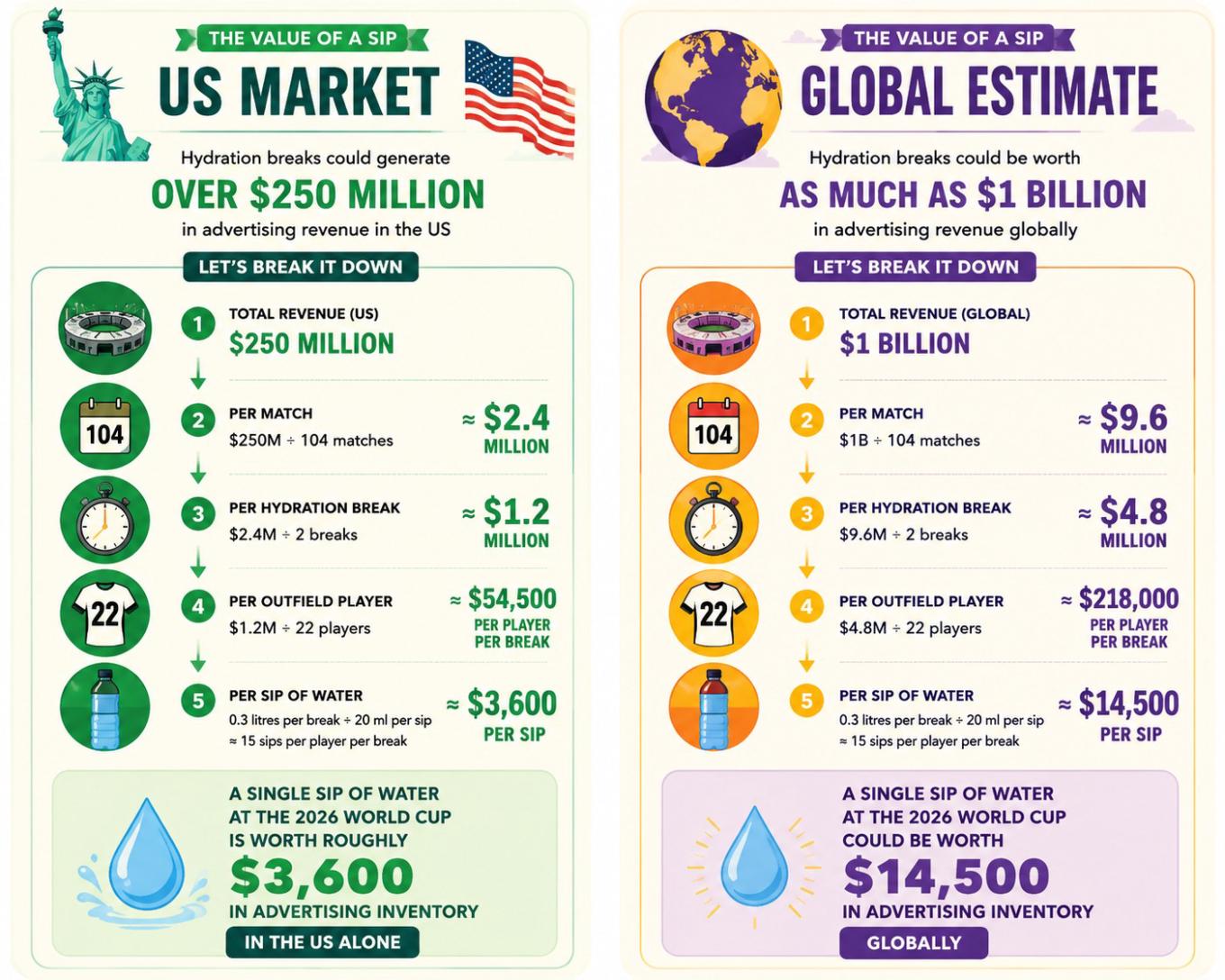
Reports suggest that a 30-second World Cup ad slot on Fox Sports costs between $200,000 and $300,000, rising to as much as $750,000 during key matches. Based on these numbers, advertising during hydration breaks in the US alone could generate over $250 million. That makes one sip a player takes on the pitch quite expensive, literally. Let’s break it down.
If we take the $250 million estimate for US hydration-break advertising revenue and divide it by 104 matches, we get roughly $2.4 million per match. Split that across two hydration breaks per match, and it comes to about $1.2 million per break. Divide that again among 22 outfield players, and you arrive at roughly $54,500 per player per break.
Now translate that into drinking water. If we assume each player drinks about 0.3 litres during a break, and that an average sip is around 20 ml, that works out to roughly 15 sips per player per break. So $54,500 per player per break divided by 15 sips comes to roughly $3,600 per sip.
A single sip of water is therefore worth thousands of dollars in advertising inventory, and this is if we take the US only. It’s estimated that the global value of hydration-break advertising could approach as much as $1 billion.
So let’s recalculate.
Starting from the $1 billion global estimate:
- Divide by 104 matches → about $9.6 million per match
- Divide by 2 hydration breaks per match → about $4.8 million per break
- Divide by 22 outfield players → about $218,000 per player per break
- Divide by 15 sips per player → about $14,500 per sip
In other words, depending on whether you look at the US market alone or the global broadcast ecosystem, a single sip of water at the 2026 World Cup may be worth somewhere between $3,600 and $14,500 in advertising inventory.
Of course, this is still just an illustrative calculation. Not every player drinks the same amount, not every broadcaster monetizes every second equally, and real-world broadcast conditions are more complex than clean equations suggest. But even with all those caveats, the scale is hard to ignore.
Americanization of sports or the rise of the ad-supported world?
Everything we’ve described so far can be seen as the symptom of the Americanization of football. After all, American sports have long embraced commercial interruptions. The Super Bowl is as famous for its ads as it is for the game itself, with many international viewers watching primarily for music performances and commercials. The NBA Finals have drawn criticism for years over halftime shows where commercials often take up more than half of the break, leaving just a few minutes for actual analysis. In other words, stopping the action to sell advertising is nothing new in the US.
But framing this purely as a regional factor would be an oversimplification. Fox does run commercials during hydration breaks, but broadcasters in many other countries do the same. This isn’t one country’s television culture spreading globally; it’s the ad-supported model quietly becoming the default everywhere.
Over the past few years, we’ve seen streaming services roll out ad-supported tiers while making ad-free subscriptions increasingly expensive. Ads are now appearing across every corner of smart TV interfaces, even on idle screens and when connected via HDMI inputs. Football has simply become the latest frontier.
We wouldn’t be surprised if hydration breaks become a permanent feature at FIFA events. The next World Cups are scheduled for Spain, Portugal, and Morocco in 2030, followed by Saudi Arabia in 2034. All of them are host nations where players will likely contend with extreme summer heat. If broadcasters discover that these breaks generate hundreds of millions in revenue, it’s hard to imagine there will be much enthusiasm for giving them up. Even if monetization was never FIFA’s original intention, the organization is unlikely to ignore the fact that mandatory breaks increase the commercial value of broadcast rights. The next broadcasting deal could simply cost more because of them.
If this strategy proves successful, why stop at hydration breaks? By 2050, we might see snack breaks sponsored by McDonald's, restroom breaks sponsored by Charmin, or recovery breaks sponsored by Gatorade. These are probably the most obvious guesses, not necessarily the most imaginative ones, but even they sound absurd. Then again, so did mandatory commercial breaks during football matches just a few years ago.