ネットワーク
この記事では、システムレベルでお使いのデバイスを保護する多機能広告ブロッカー、「AdGuard for Windows」について書いています。 実際どのように機能するのかを確認するには、 AdGuard アプリをダウンロードしてください。
この「ネットワーク」モジュールはネットワークフィルタリング専用のもので、ネットワーク関連の追加オプションがあります。 このうち、「トラフィックフィルタリングを有効にする」と「HTTPS をフィルタリングする」は、デフォルトで有効になっています。 これらは、あなたのウェブスペースをより良くフィルタリングするための重要な追加予防措置です。 Most websites are now using HTTPS, and the same applies to advertising. youtube.com、facebook.com、x.comなど多くのウェブサイトでは、HTTPSフィルタリングなしでは広告を削除することができません。 そのため、特別な理由がない限り、「HTTPSをフィルタリングする」機能は有効にしておいてください。
このモジュールでは、「HTTPプロキシとしてAdGuardを使用する」チェックボックスをオンにすると、AdGuardを通常のHTTPプロキシとして使用し、通過するすべてのトラフィックをフィルタリングできます。 「EV証明書を持つウェブサイトをフィルタリング」オプションを有効にすることもできます。 EV (Extended Validation) SSL証明書は、ウェブサイトの所有者がEVガイドラインで定義されている国際標準化された徹底的な身元確認プロセスに合格したことを保証します。 これは、このような証明書を持つウェブサイトを信頼してフィルタリングをしないようなユーザーがいる理由でもあります。
最後に、プロキシ設定のセクションがあります。 そこで、AdGuard がフィルタの更新や新バージョンの取得などに使用するプロキシサーバーを指定できます。
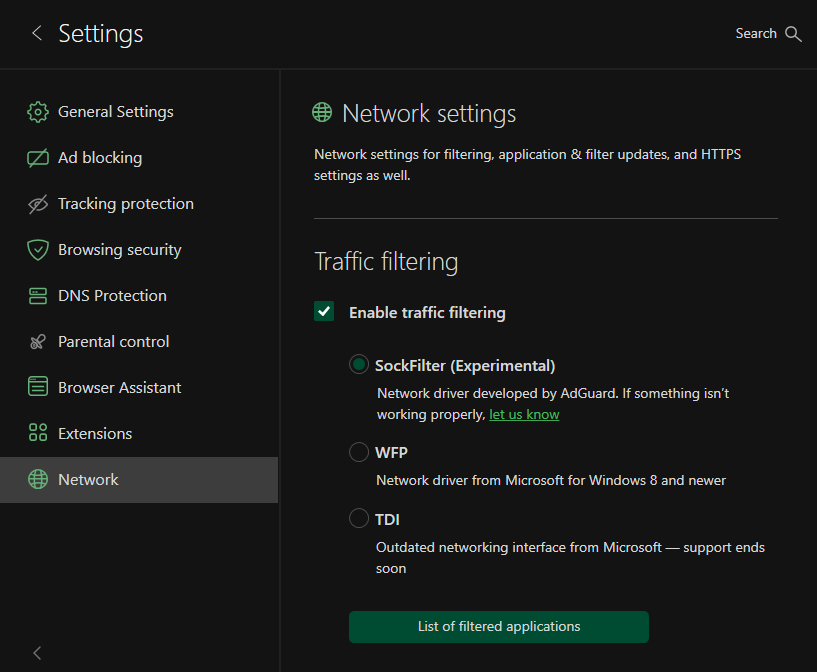
Enable traffic filtering
Traffic filtering is the core mechanism that allows AdGuard to inspect and control the network traffic generated by applications on your computer. When it is enabled, AdGuard intercepts outgoing and incoming connections and checks them against its filtering rules. If a request matches a blocking rule, AdGuard can block it, modify it, or allow it depending on the configuration. In AdGuard for Windows, this interception is implemented through network drivers.
If HTTPS filtering is enabled, AdGuard performs a controlled local TLS interception: it decrypts the traffic using its local certificate, applies filtering rules, and then re-encrypts the traffic before sending it to the browser. The driver simply provides the system-level access needed for AdGuard to intercept these connections.
In Network, you can also enable traffic filtering and choose which driver to use: SockFilter, WFP, or TDI.
SockFilter
SockFilter is an experimental, lightweight kernel-mode network driver that works at the socket level (TCP/UDP). Instead of inspecting or modifying packets as they travel through the full Windows networking stack, a sock filter intercepts socket calls (e.g., connect, send, receive, bind) at a higher, more stable abstraction level. This makes it ideal for applications that need to monitor or control network activity without deep packet processing.
SockFilter was first implemented in version 7.22.4, and it is still considered unstable — you may encounter bugs. Once fully tested and implemented, SockFilter has the potential to offer several advantages over other drivers:
- It operates at a higher, socket-level layer: SockFilter works with socket operations rather than raw packets, making it less complex and more stable than WFP’s low-level packet filtering.
- No interference with other network drivers: Because it sits above VPN, firewall, and antivirus WFP filters, it avoids filter-ordering problems and compatibility conflicts common in the WFP stack.
- Greatly reduced risk of NETIO-related BSODs: SockFilter doesn’t run inside the NETIO packet pipeline, so it avoids the typical crash scenarios caused by WFP callouts mishandling buffers, classification results, or packet memory.
When it comes to disadvantages, SockFilter driver sees only socket-level operations and does not capture traffic generated by other kernel drivers or components that bypass the standard Winsock API. From a low-level networking perspective, this can be viewed as a limitation, since the driver cannot access raw packets or inspect non-socket traffic. However, for an ad-blocking application, this behavior is not just acceptable but optimal. All relevant traffic from browsers and user-mode applications goes through standard sockets, and that’s exactly what we need to control. At the same time, ignoring low-level driver traffic removes unnecessary complexity, avoids compatibility issues, and keeps the system stable.
WFP
WFP (Windows Filtering Platform) is a Microsoft networking framework built into Windows that allows software to filter and monitor network packets at different layers of the system networking stack. AdGuard uses WFP to safely hook into the network flow of applications and apply filtering rules before the traffic reaches the browser or the Internet. More information.
While it is a powerful driver, it may present stability risks, such as occasional system crashes (BSOD) and lower Internet speed for some users.
TDI
The TDI driver is also available, but it is outdated and may cause filtering issues in some versions of Google Chrome. A temporary workaround exists, but it’s not a reliable long-term solution.
AdGuard VPN
The last section is dedicated to AdGuard VPN — an ideal tool that provides security and anonymity each time you browse the Internet. You can download it by clicking the Download button or go to the AdGuard VPN website by clicking the Homepage button.
How does AdGuard VPN work? Without going into technical details, we can say that VPN creates a secure encrypted tunnel between the user's computer or mobile device and a remote VPN server. In this way, data privacy is preserved, as well as the anonymity of the user, because a third-party observer sees the IP address of the VPN server and not the actual user's IP.
What AdGuard VPN does:
- hides your real whereabouts and helps you stay anonymous
- changes your IP address to protect your data from tracking
- encrypts your traffic to make it unreadable to third parties
- lets you configure where to use VPN and where not to (exclusions feature)
To get more information about AdGuard VPN, dive into the AdGuard VPN Knowledge Base.