$5 Billion Worth Man-Made Disasters Then and Now
We as a mankind developed ourselves a habit to measure everything in money, even such grim matters as the aftermath of disasters. For such megacatastrophes as Chernobyl the economic impact they had is almost impossible to estimate. For other ones we usually can assess the damages. For example, another infamous nuclear accident - Three Mile Island - is estimated by experts to cost the economy about $2.5 billion.
The catastrophes of today don't always involve casualties and explosions. This summer we became witnesses to a historical event: the Federal Trade Commission evaluated the damage Facebook has done with its users' personal data mishandling to be worth $5 billion in fines. Just think of it: it's twice as much as caused by a partial meltdown of a nuclear reactor.

Facebook paid by far the record amount in fines in the history of data protection.
Where does such impossibly large number come from? Sadly, people still don't realize how much their personal data can be worth. Companies want to know everything about you: your name, home and work addresses, income, medical conditions... There are literally hundreds of items in your online profile. This information costs a lot, and it's usually obtained by online ads and trackers.
To understand people’s awareness of this matter we conducted a survey among the visitors of our website and asked them about their attitude towards tracking and advertising.
Ad blockers are just to block ads. Right?
I mean, that's literally in the name. What else could they be good for?
Unfortunately, a lot of people hold this opinion. And in reality, many ad blockers (of course, AdGuard included) block trackers just as good, if not better than ads. First we asked the respondents a very simple question:
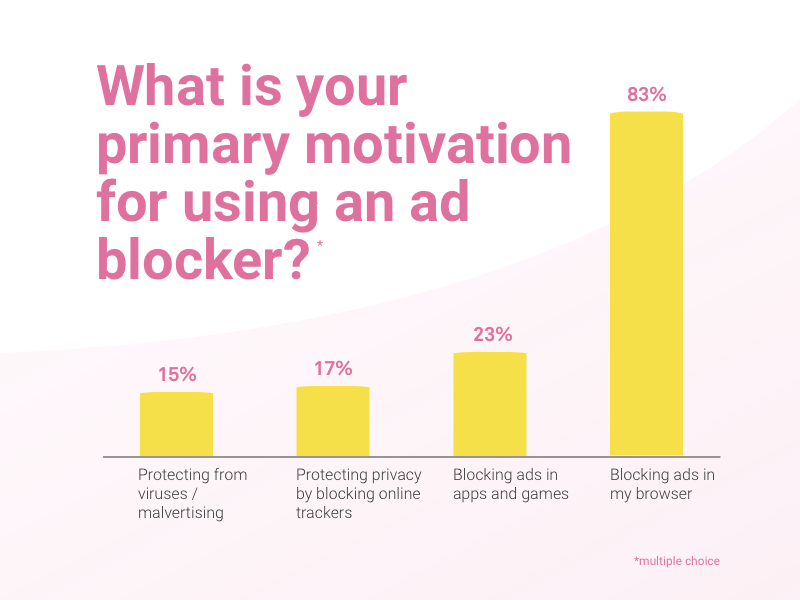
This is a unified statistic for desktop and mobile users.
While online ads (and specifically in-browser ads) are unsurprisingly by far the main reason why people install an ad blocker, we also see that many respondents named tracking and malvertising as their main motivation. It demonstrates that people are not just irritated by ads, they actually feel threatened by them. Good thing AdGuard takes care of trackers and malvertising just as well as regular ads.
Turns out there are different reasons to install an ad blocker, but what excuses can there possibly be to not run it? Now that's a curious question, and we have an answer:
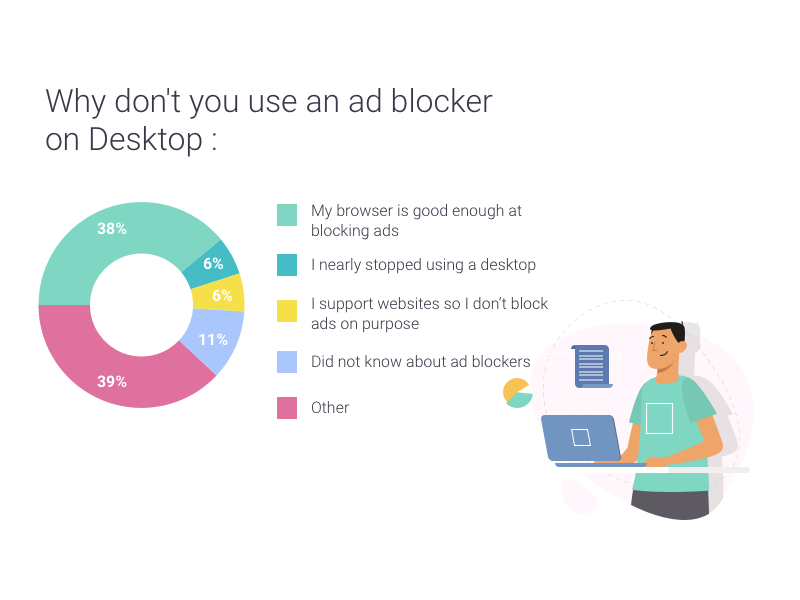
Desktop users don't like ads much.
For desktop, the leading choice (and the only one with more than 15% of responses) is "My browser is already good at blocking ads". That's very telling. Even people who don't use ad blockers still block ads! Makes you scratch your head a little. Maybe mobile users have a higher tolerance towards ads?
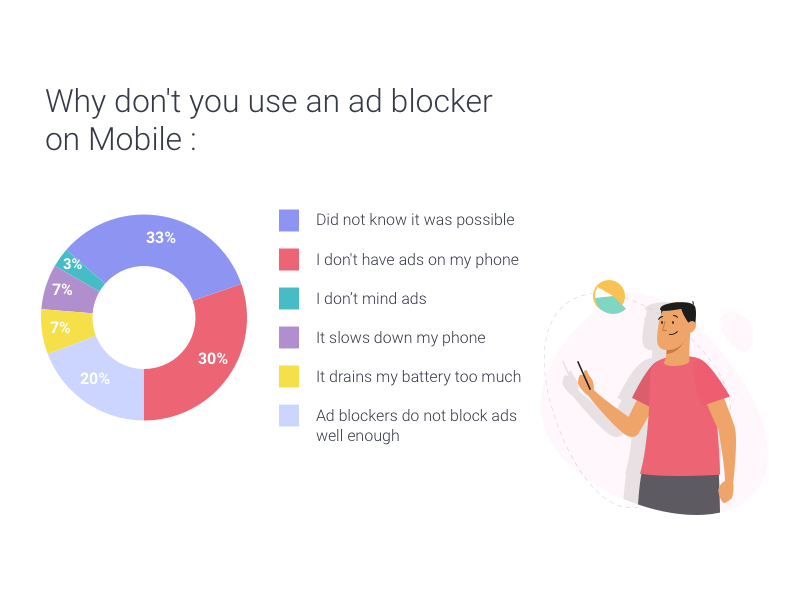
They don't.
Mobile users voted a bit differently. A lot of them still don't know about mobile ad blockers. It's easy to imagine many would use them if only they knew. By the way, almost 20% don't think ad blockers for mobile platforms are effective. Sadly, this is closer to truth than we'd like it to be, especially on iOS where Apple has full control and is very keen on keeping ad blockers Safari-exclusive (and comparatively weak even there).
The bottom line is: people don't want to see ads. What a shocker. Let's find out if it's any different for tracking.
How much do you value your privacy?
That's a very important question we wanted to know the answer to. Facebook has become the privacy boogeyman, but truth be told, there's a plethora of other companies that have been involved in big privacy-related scandals and fines are being paid left and right. Is online privacy really as big a deal to common people as to media and authorities?
Maybe it is possible that most internet users are fine with today's state of affairs? Spoiler: No, they are not. There's a little bit of a bias here perhaps, as people who end up on an ad blocker's website are more likely to have a stronger opinion on this topic; but some of these results simply can't be misinterpreted.
As a bridge to the privacy-related portion of our survey, we asked the respondents:
Look for me somewhere inside that big circle.
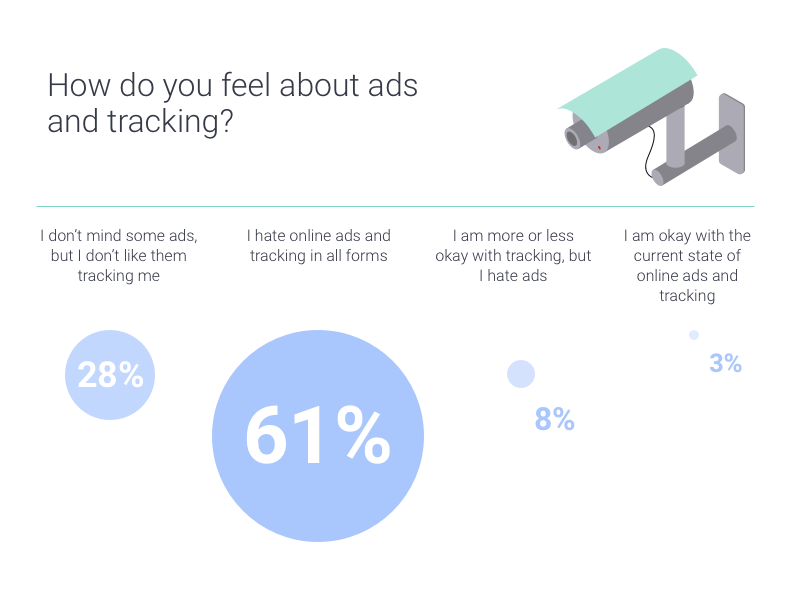
Over 60% of respondents hate any ads and/or tracking. Wow. Combined with the "don't mind ads, hate tracking" choice, almost 9 out of 10 don't want anyone watching them and their actions online. And you know what? We at AdGuard completely understand them. But how deep does the hatred towards tracking lie?
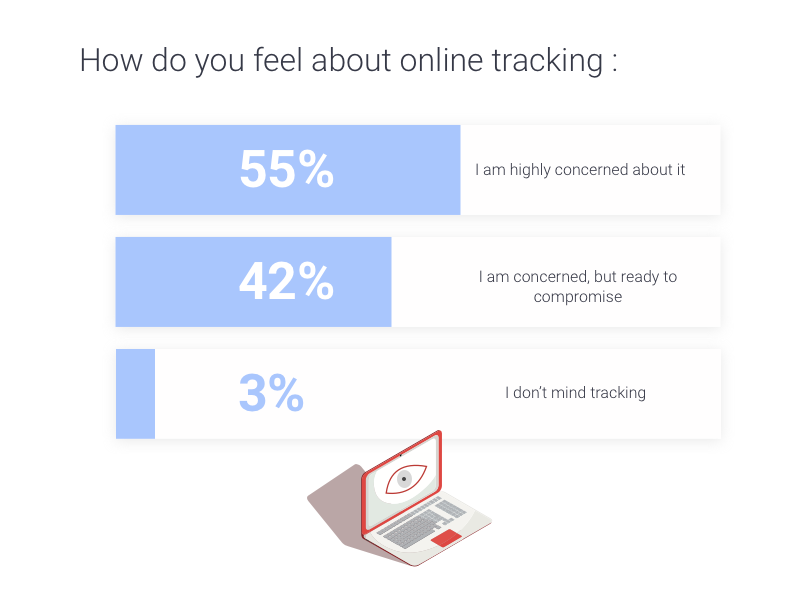
Not minding tracking makes you special!
Now, this graph shows that a significant portion of respondents, despite being concerned with tracking, are ready for compromises. Notice that they still don't intend to allow all and any tracking. In fact, only 3% do. If you wonder, what types of tracking people might put up with, we have an answer too:
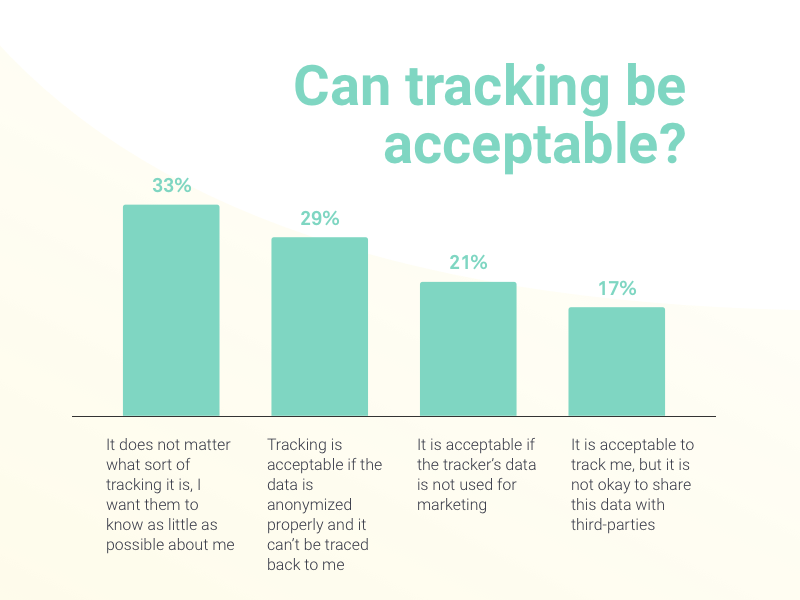
Remember kids! Track responsibly!
Opinions divided here. One-third don't believe in such a thing as 'acceptable tracking'. Others can condone some of it, but only as long as their data doesn't become a product. Hardly anyone likes it when their personal information is used for marketing and gets sold and purchased.
To wrap up the topic, my personal favorite question of the survey:
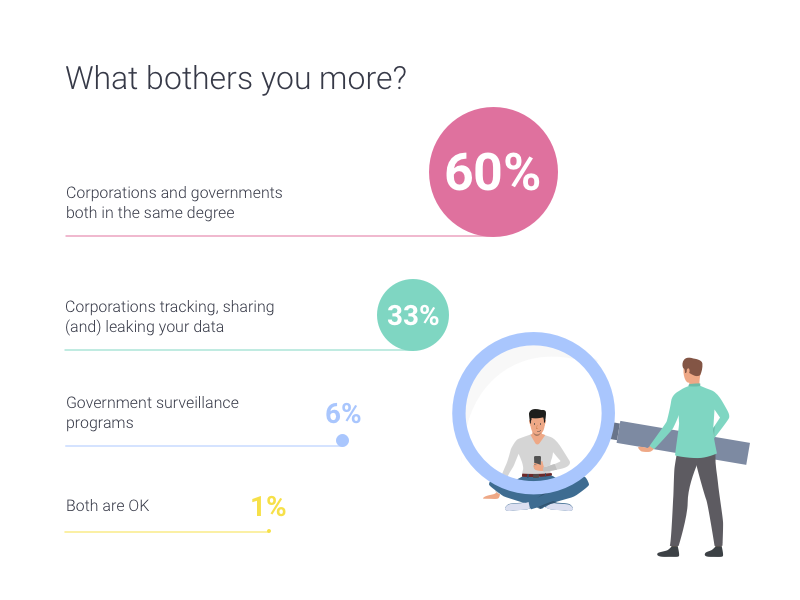
It's like choosing which bully you'd rather take your lunch money.
It turns out, corporations are viewed as a greater evil than governments. Who knows, maybe it's because they have long outrun governments in tracking efficiency?
Relations with content publishers
Despite what you and me like or want, websites still make lots of money off advertising. Even websites that carry a positive public image, the ones that provide useful content and attract a lot of visitors - they almost always have ads too. By blocking ads, ad blocker users deprive these websites ad revenue. It raises a question: how do ad blocker users support websites they like?
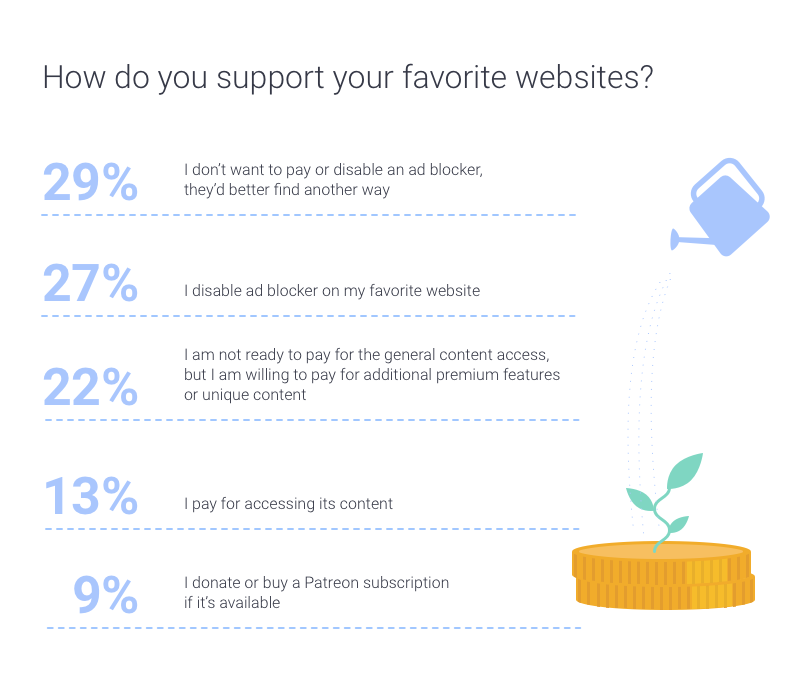
Cat pictures won't post themselves! At least not for free.
Right off the bat, 3 out of 10 don't want to pay or disable their ad blocker, plain and simple. It's not for us to judge whether it's fair or not, but it looks like that's how almost a third of internet folks feel, and websites need to adapt to that. Another third are ready to pay in some way, be it for premium content or just to access the website at all. And a quarter of respondents find it acceptable to disable ad blocker for their favorite websites.
What conclusions can be made from here? I'm not sure, but it looks like some kind of equilibrium can be achieved, where both content producers and content consumers will be satisfied. Here's to hoping!
Our final question was about ad walls - one of the possible (not really) ways of content monetization. AdWall is when a website doesn't allow you to access its content with an enabled ad blocker.
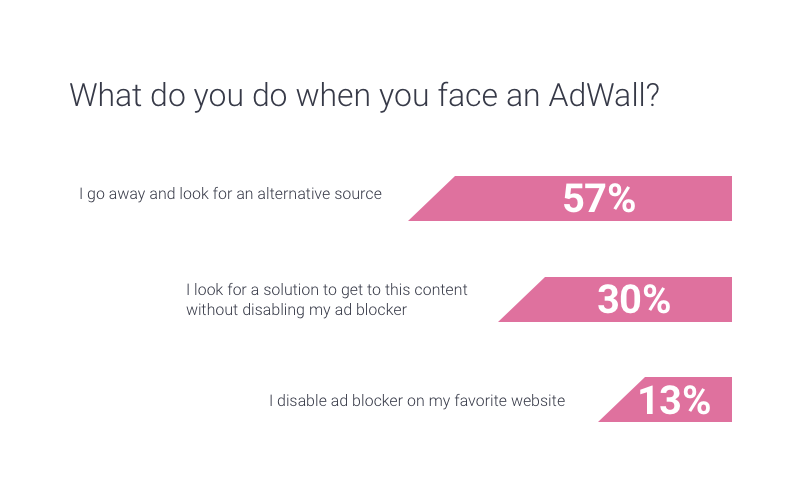
All in all, no one wants yet another adwall.
Judging from the experience, and this survey only confirms it, this is a road to nowhere. 87% of respondents are not ready to disable their ad blocker. In the end, nobody is happy in this case: websites lose visitors and users get denied of the content.
We feel strongly against this practice, but at the same time we believe that websites have a right to have a dialog with users, so we don't block adwalls (not mentioning that it's illegal in some countries). Fortunately, lately website owners seem to start realizing that adwalls are a no go, and so they are becoming less and less present.
AdGuard has been developing products that protect from ads and tracking for 10 years now, and we've been shouting about the importance of privacy pretty much on every corner. As we always try to learn on our own mistakes with disasters to avoid them in the future, we should try to learn how to prevent companies from stealing and misusing our data. If we change nothing, the history will only repeat itself. And you can't rely on committees and policies to keep your personal data private: even if Facebook has to pay another monstrous fine, the damage will be done already. With privacy, everyone should start with themselves.