A recap of 2018 in ad blocking
In late December we posted a recap of 2018 from AdGuard's point of view. But the year didn't happen in a vacuum; we are all in this together — ad blocker developers, ad blocker users, and advertisers. So anything that happens in the "world of ad blocking" concerns both us and you, the users. Let's look back at the most noteworthy events in the industry, assess their impact, and try to make some predictions for the next year.
By the way, in the previous year we wrote a similar post about 2017 and also made some predictions for 2018. Without false modesty, we can say that all of them came true! Let's use those predictions as a springboard to jump into the last year's recap.
Looking back at our predictions for 2018
- The value of personal data
- New startups or large players?
- Smartphones
- Anti-adblocking and ad reinsertion
- Connected home, AR, voice recognition and privacy
- Cryptojacking
- Ad blockers start to work together
Our predictions for 2019
The value of personal data
Our prediction:
The value of personal data is growing, along with the understanding of this value by users. As data gets processed in more and more sophisticated ways, the risks of abuse get higher and at the same time more comprehensible.
Did it come true?
Absolutely.

We hit the bullseye with this one. In the modern world, information costs money, and companies pay insane amounts for the personal data of their potential users. People quickly realized the value of their personal information, and more and more of them take active measures to protect their privacy today. One example: last year, after a series of privacy-related scandals, almost 75% of all Facebook users took actions to restrict FB's access to their personal data; 1 in 4 actually deleted the FB app from their phones.
Our prediction:
The start of GDPR implementation in May 2018 will also trigger a surge in interest in personal data protection.
Did it come true?
Obviously, yes.

The GDPR coming into full force this year was a great factor in increasing the appreciation of privacy. Companies now can't afford to hide data leaks — you could easily notice it just by the increase in popularity of this topic in the news. Facebook, of course, was the absolute champion in that regard this year ([1], [2], [3]).
One of the less obvious positive impacts of GDPR is that it kind of opened the floodgates. Now there are talks about more similar regulations; for example, California (US) already passed a law that will grant its residents more control over their personal information online.
New startups or large players?
Our prediction:
Interesting new startups in the niche of protection from aggressive marketing (ad blocking, anti-tracking) will appear, but the market trends (and the activity of popular browser developers) are more favorable for the evolution of large players than for the emergence of new ones.
Did it come true?
Yes.
Perhaps this prediction wasn't the hardest to make, but still. Large corporations are still setting the rules of the game.
- Google went as far as blocking ads itself and even founding the Coalition for Better Ads. Now, Google will decide which ads are suitable for you, and it is, of course, a total and complete mystery what ads will be chosen (except it is not).
- Mozilla first implemented tracking protection in its Firefox browser, and then evolved it to content blocking.
- Apple continues to develop Intelligent Tracking Protection in Safari.
All in all, there is a clearly visible trend: it is absolutely impossible to fight the surge of ad blockers on desktops. This is what people want and this is what they will use, one way or another. If you can't beat them, lead them — Google knows this best of all, it seems.
It is a different story for mobile devices, and we will talk about that later.
Smartphones
Our prediction:
Ad blocking on smartphones is unlikely to grow at a significant pace in Europe and the US: smartphones are too dependent on their ecosystem’s developers (Google, Apple), and these developers do not like anti-marketing products. They let browsers with ad-restriction features exist on their platforms, but this is a niche product for geeks.
Did it come true?
It is happening right now.

Ad blockers are not allowed in the big app stores: Amazon, Apple and Google all made it impossible for real ad blockers (not parodies that these stores are teeming with) to be distributed via their platforms. We experienced it first-hand, and while Google has long been known for this stance, Amazon and Apple joined the mob only this year.
You might say, wait a sec! Didn't Apple add an entire content blocking technology to Safari? They did, but it is laughable. Safari Content Blocking API was basically abandoned after its launch, it is in utter stagnation. And we know like no one else that you can't fight ads, especially ad recover/reinjection startups, without continuous innovation.
Moreover, the main offenders to privacy on mobile phones have always been apps, not browsers. There is no shortage of evidence for this claim, just look at our Facebook research. And any attempts to confront apps when they try to collect users' data come up against fervent resistance from none other than those same big corporations.
Anti-adblocking and ad reinsertion
Our prediction:
The anti-adblocking and ad reinsertion markets will continue to grow. A third of the sites from Alexa’s top 10,000 are already working with ad blocking users in some way.
Did it come true?
No doubt.
As ad blockers grow, these technologies continue to grow too. It should be mentioned that more and more websites are moving away from the adblock wall strategy (because it simply doesn't work, as multiple examples demonstrate), and towards ad reinsertion (technology that helps circumvent ad blockers).
The arms race is in full swing. Ad blockers are honing their anti-ad tools, and companies that specialize in ad recovery are studying bypass mechanisms. And there is no end in sight.
Connected home, AR, voice recognition and privacy
Our prediction:
Advertising technologies related to augmented reality, voice recognition <...> will evolve. Active penetration of connected devices in homes will continue, and new privacy, data loss and abuse scandals will arise. Attempts to regulate IoT legislation will be made, probably in the EU, maybe in the US. <...> Brands continue to master the marketing potential of voice AI assistants.
Did it come true?
It did, and it was hard to miss.
As the old joke goes, "the letter "P" in "IoT" stands for "privacy." Everything that touches IoT is a complete mess, a war zone. There are virtually no rules, companies accumulate ridiculous amounts of very sensitive data from voice assistants and smart furniture, and they are not particularly careful with it. Data losses happen left and right, here is a good example: Amazon sends 1.700 Alexa voice recordings to the wrong user. If you think this is somehow an exception to the rule, you are very wrong. Here is Alexa being hacked, again. And here Google Home joins the party.
The first attempts to regulate the data security of the Internet of Things have been made, too. The most notable is the Californian IoT legislation aimed at protecting Californian users' privacy.
Cryptojacking
Our prediction:
Threats related to crypto-currencies will not lose relevance. Scripts for stealth mining (cryptojacking) will continue to be found in the most unexpected places.
Did it come true?
Mostly yes.

Everything crypto-related may seem to be on the slow side now, but a recent study showed a 400% increase in instances of cryptojacking since last year. Throughout the year we had several occasions to talk about cryptojacking. In this article, we conducted a research and found out that some of the most popular video hosting sites were involved in a cryptojacking scheme.
Ad blockers start to work together
Our prediction:
Ok, we didn't make such prediction. But we meant it!
November 2018 marked (hopefully) a new milestone in the ad blocking industry. The first Ad-Blocking Developer Summit gathered developers from all over the world to discuss the current state and the future of the ad blocking industry. We are proud to have been part of it, and hope that such conferences will become regular. If advertisers and big companies can work together, why can't we too?

It is easy to underestimate the importance of this event, especially since it wasn't talked about much outside of the developer circle, but that would be a mistake. We will try to post a separate article about the results of this conference, and how we view them, later.
Our predictions for 2019
Let's see if we can nail the predictions just as well this time around. Here are some of the ad blocking trends we expect to see this year.
The growth of traditional ad blockers will slow down or stop completely
It seems that almost everyone who wanted to block ads has already learned how to do it and installed an ad blocker. In addition to that, many browsers are now trying to block ads on their own in one way or another. Yes, they do a noticeably worse job than traditional ad blockers, but this is enough to slow down the growth, which is already not as huge as it used to be several years ago.
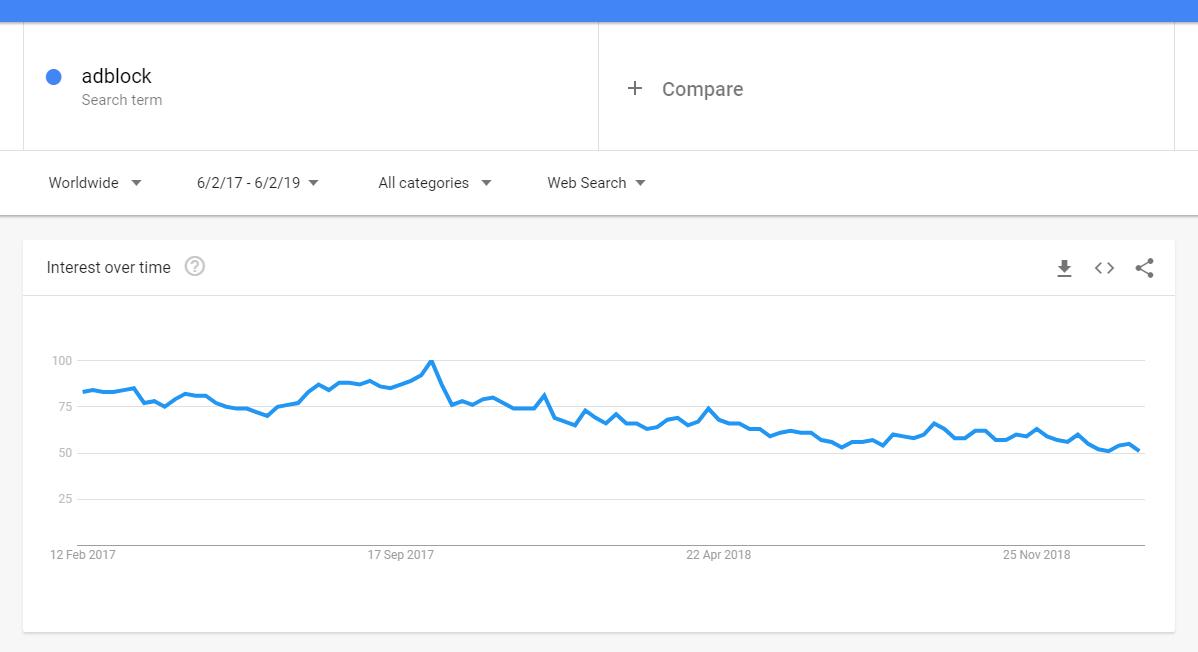
Also, innovations in ad blocking are becoming increasingly difficult, considering that browsers constantly put spokes in ad blockers' wheels ([1], [2]). Mobile ad blockers could have been a saving grace for the growth of the industry, and the growth is indeed there, but it is just too slow. No breakthroughs are expected in 2019 either.
The big companies that set the rules of the game just don't want ad blockers, plain and simple. We will hear more about Google Fuchsia (a new OS developed by Google), and we will not like this news.
The situation we describe might seem quite grim, but it will not last forever. There will be a new wave of ad blockers sooner or later, independent from artificial ecosystems set up by big companies. We expect a shift in new ad blockers' priorities, with more emphasis on privacy protection.
Yet another boom in interest towards privacy is coming in 2019
The GDPR shook everyone big time, but this is all just the beginning. Many companies have not taken this law seriously enough, but when the first large fines are exacted in 2019, they will have to review their priorities.
Another major event to look forward to is the new California Privacy Law coming into full force in January 2020. Some US companies simply restricted access for European users and did not do anything about the GDPR. It is very possible they will have to rethink their approach very soon.
More paywalls, more subscriptions
This trend appeared earlier, but it will continue through 2019. The Guardian, New Yorker, ArsTechnica, and many, many others, are trying to diversify their business and stop being dependent on advertising profits.

By the way, we do not think this is all about ad blockers. As we said before, their share is growing very slowly and some kind of "adblockalypse" (which some had expected) never happened. The real reason is, companies like BuzzFeed and Vox Media were built on the expectation of fast growth in advertising sales. Instead, they have found that Facebook and Google – “the duopoly” – have simply tightened their grip on digital advertising revenue.
It is rather ironic that all along, the reason for the various media's revenue problems was not ad blockers (as everybody feared), but the advertising giants Google and Facebook.
Innovations in ad blocking will come, but you will not see them
Even though we said that innovations in ad blocking are being impeded, that doesn't mean there won't be any. For example, there is a lot of talk about the use of AI technology in ad blockers, like automatic recognition of advertising on webpages ([1], [2], [3]).
Such technologies are really evolving, but we doubt that there will be any breakthroughs in 2019. The rate at which these technologies find their groove will grow gradually, and at first they will find applications mostly on the back end. Think automatic filter analysis, site monitoring, and so on. So far these technologies are not ready to be implemented in ad blockers.