Red
Este artículo trata sobre AdGuard para Windows, un bloqueador de anuncios multifuncional que protege tu dispositivo a nivel de sistema. Para ver cómo funciona, descarga la app de AdGuard
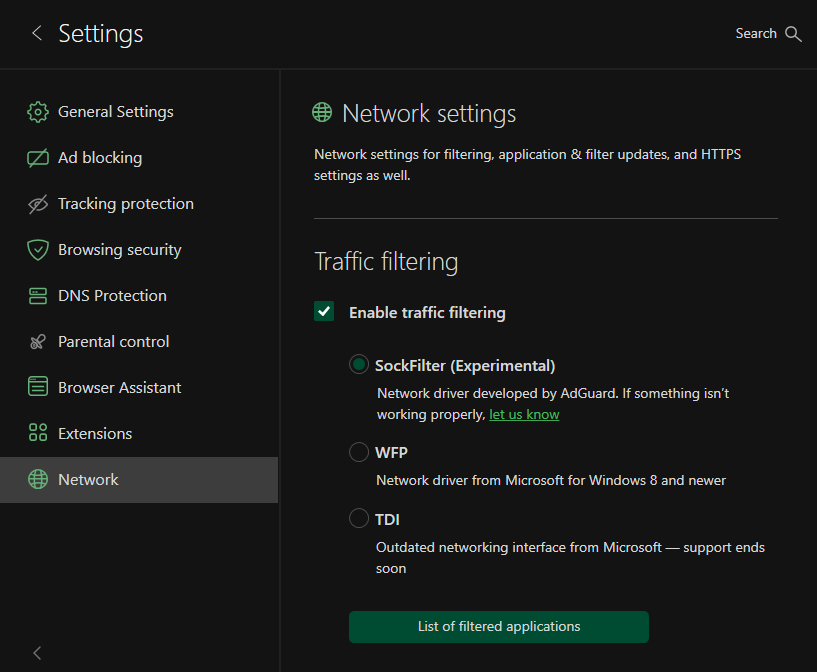
El módulo de red está dedicado al filtrado de redes y aquí encontrarás opciones adicionales relacionadas con la red. Dos de ellos están habilitados de forma predeterminada: Habilitar filtrado de tráfico y Filtrar HTTPS. Estas son precauciones adicionales importantes para filtrar mejor tu internet. La mayoría de los sitios web utilizan ahora HTTPS y lo mismo se aplica a la publicidad. En muchos sitios web, como youtube.com, facebook.com y x.com, es imposible eliminar anuncios sin el filtrado HTTPS. Así que mantén habilitada la función Filtrar HTTPS a menos que tengas una buena razón para no hacerlo.
En este módulo, puedes marcar la casilla de verificación Usar AdGuard como proxy HTTP para usar AdGuard como un proxy HTTP normal que filtrará todo el tráfico que pasa a través de él. También puedes habilitar la función Filtrar sitios web con certificados EV. Los certificados SSL de validación extendida (EV) ofrecen una garantía de seguridad más sólida; los propietarios de dichos sitios web deben pasar un proceso de verificación de identidad exhaustivo y estandarizado a nivel mundial definido por las directrices EV. Esta es la razón por la que algunos usuarios confían en sitios web con dichos certificados y prefieren no filtrarlos.
Por fin, hay una sección con configuración de proxy. Allí puedes especificar qué servidor proxy AdGuard debe utilizar para actualizar los filtros, obtener nuevas versiones, etc.
Enable traffic filtering
Traffic filtering is the core mechanism that allows AdGuard to inspect and control the network traffic generated by applications on your computer. When it is enabled, AdGuard intercepts outgoing and incoming connections and checks them against its filtering rules. If a request matches a blocking rule, AdGuard can block it, modify it, or allow it depending on the configuration. In AdGuard for Windows, this interception is implemented through network drivers.
If HTTPS filtering is enabled, AdGuard performs a controlled local TLS interception: it decrypts the traffic using its local certificate, applies filtering rules, and then re-encrypts the traffic before sending it to the browser. The driver simply provides the system-level access needed for AdGuard to intercept these connections.
In Network, you can also enable traffic filtering and choose which driver to use: SockFilter, WFP, or TDI.
SockFilter
SockFilter is an experimental, lightweight kernel-mode network driver that works at the socket level (TCP/UDP). Instead of inspecting or modifying packets as they travel through the full Windows networking stack, a sock filter intercepts socket calls (e.g., connect, send, receive, bind) at a higher, more stable abstraction level. This makes it ideal for applications that need to monitor or control network activity without deep packet processing.
SockFilter was first implemented in version 7.22.4, and it is still considered unstable — you may encounter bugs. Once fully tested and implemented, SockFilter has the potential to offer several advantages over other drivers:
- Opera en una capa superior, a nivel de socket: SockFilter trabaja con operaciones de socket en lugar de paquetes sin procesar, lo que lo hace menos complejo y más estable que el filtrado de paquetes de bajo nivel de WFP.
- No interference with other network drivers: Because it sits above VPN, firewall, and antivirus WFP filters, it avoids filter-ordering problems and compatibility conflicts common in the WFP stack.
- Riesgo de BSOD relacionados con NETIO considerablemente reducido: SockFilter no se ejecuta dentro del pipeline de paquetes de NETIO, por lo que evita los escenarios típicos de fallos causados por callouts de WFP que manejan incorrectamente los búferes, los resultados de clasificación o la memoria de paquetes.
When it comes to disadvantages, SockFilter driver sees only socket-level operations and does not capture traffic generated by other kernel drivers or components that bypass the standard Winsock API. From a low-level networking perspective, this can be viewed as a limitation, since the driver cannot access raw packets or inspect non-socket traffic. However, for an ad-blocking application, this behavior is not just acceptable but optimal. Todo el tráfico relevante de los navegadores y aplicaciones en modo usuario pasa por sockets estándar, y eso es exactamente lo que necesitamos controlar. At the same time, ignoring low-level driver traffic removes unnecessary complexity, avoids compatibility issues, and keeps the system stable.
WFP
WFP (Windows Filtering Platform) is a Microsoft networking framework built into Windows that allows software to filter and monitor network packets at different layers of the system networking stack. AdGuard uses WFP to safely hook into the network flow of applications and apply filtering rules before the traffic reaches the browser or the Internet. More information.
While it is a powerful driver, it may present stability risks, such as occasional system crashes (BSOD) and lower Internet speed for some users.
TDI
The TDI driver is also available, but it is outdated and may cause filtering issues in some versions of Google Chrome. A temporary workaround exists, but it’s not a reliable long-term solution.
AdGuard VPN
The last section is dedicated to AdGuard VPN — an ideal tool that provides security and anonymity each time you browse the Internet. You can download it by clicking the Download button or go to the AdGuard VPN website by clicking the Homepage button.
How does AdGuard VPN work? Without going into technical details, we can say that VPN creates a secure encrypted tunnel between the user's computer or mobile device and a remote VPN server. In this way, data privacy is preserved, as well as the anonymity of the user, because a third-party observer sees the IP address of the VPN server and not the actual user's IP.
What AdGuard VPN does:
- hides your real whereabouts and helps you stay anonymous
- changes your IP address to protect your data from tracking
- encrypts your traffic to make it unreadable to third parties
- lets you configure where to use VPN and where not to (exclusions feature)
To get more information about AdGuard VPN, dive into the AdGuard VPN Knowledge Base.