Réseau
Cet article parle de AdGuard pour Windows, un bloqueur de contenus multifonctionnel qui protège votre appareil au niveau du système. Pour voir comment ça fonctionne, téléchargez l'application AdGuard
Le module Réseau est dédié au filtrage réseau, et vous y trouverez des options supplémentaires liées au réseau. Deux d'entre elles sont activées par défaut : Activer le filtrage du trafic et Filtrer HTTPS. Ce sont des précautions supplémentaires importantes pour mieux filtrer votre espace web. La plupart des sites web utilisent désormais HTTPS, et il en va de même pour la publicité. Sur de nombreux sites, comme youtube.com, facebook.com, et x.com, il est impossible de supprimer les publicités sans filtrage HTTPS. Il est donc recommandé de garder l'option Filtrer HTTPS activée, sauf si vous avez une bonne raison de ne pas le faire.
Dans ce module, vous pouvez cocher la case Utiliser AdGuard comme proxy HTTP pour utiliser AdGuard comme un proxy HTTP classique, qui filtrera tout le trafic passant par lui. Vous pouvez également activer la fonctionnalité Filtrer les sites web avec des certificats EV. Les certificats SSL à Validation Étendue (EV) offrent une garantie de sécurité renforcée ; les propriétaires de ces sites doivent passer un processus de vérification d'identité rigoureux et standardisé au niveau mondial, défini par les directives EV. C'est pourquoi certains utilisateurs font confiance aux sites disposant de tels certificats et préfèrent ne pas les filtrer.
Enfin, il y a une section avec les paramètres de proxy. Vous pouvez y spécifier quel serveur proxy AdGuard doit utiliser pour mettre à jour les filtres, obtenir de nouvelles versions, et ainsi de suite.
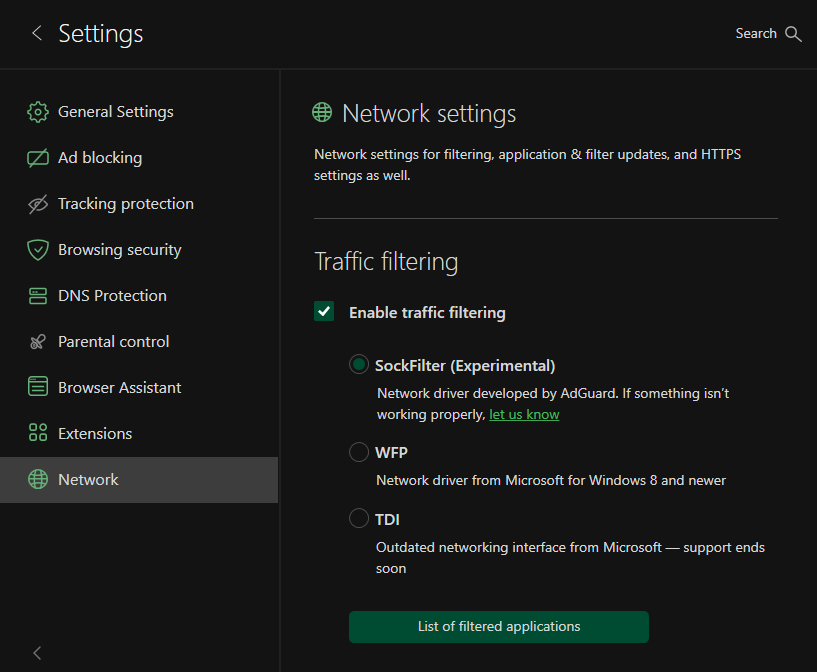
SockFilter and other network drivers
In Network, you can also enable traffic filtering and choose which driver to use: SockFilter, WFP, or TDI.
WFP (Windows Filtering Platform) is a powerful driver, but it may present stability risks, such as occasional system crashes (BSOD) for some users.
The TDI driver is also available, but it is outdated and may cause filtering issues in some versions of Google Chrome. A temporary workaround exists, but it’s not a reliable long-term solution.
SockFilter is an experimental, lightweight kernel-mode network driver that works at the socket level (TCP/UDP). Instead of inspecting or modifying packets as they travel through the full Windows networking stack, a sock filter intercepts socket calls (e.g., connect, send, receive, bind) at a higher, more stable abstraction level. This makes it ideal for applications that need to monitor or control network activity without deep packet processing.
Currently, SockFilter Right is still unstable, and you may encounter bugs. When fully tested and implemented, SockFilter has the potential to bring several advantages over other drivers:
- It operates at a higher, socket-level layer: SockFilter works with socket operations rather than raw packets, making it less complex and more stable than WFP's low-level packet filtering.
- No interference with other network drivers: Because it sits above VPN, firewall, and antivirus WFP filters, it avoids filter-ordering problems and compatibility conflicts common in the WFP stack.
- Greatly reduced risk of NETIO-related BSODs: SockFilter doesn't run inside the NETIO packet pipeline, so it avoids the typical crash scenarios caused by WFP callouts mishandling buffers, classification results, or packet memory.
When it comes to disadvantages, SockFilter driver sees only socket-level operations and does not capture traffic generated by other kernel drivers or components that bypass the standard Winsock API. From a low-level networking perspective, this can be viewed as a limitation, since the driver cannot access raw packets or inspect non-socket traffic. However, for an ad-blocking application, this behavior is not just acceptable but optimal. All relevant traffic from browsers and user-mode applications goes through standard sockets, and that's exactly what we need to control. At the same time, ignoring low-level driver traffic removes unnecessary complexity, avoids compatibility issues, and keeps the system stable.
AdGuard VPN
The last section is dedicated to AdGuard VPN — an ideal tool that provides security and anonymity each time you browse the Internet. You can download it by clicking the Download button or go to the AdGuard VPN website by clicking the Homepage button.
How does AdGuard VPN work? Without going into technical details, we can say that VPN creates a secure encrypted tunnel between the user's computer or mobile device and a remote VPN server. In this way, data privacy is preserved, as well as the anonymity of the user, because a third-party observer sees the IP address of the VPN server and not the actual user's IP.
What AdGuard VPN does:
- hides your real whereabouts and helps you stay anonymous
- changes your IP address to protect your data from tracking
- encrypts your traffic to make it unreadable to third parties
- lets you configure where to use VPN and where not to (exclusions feature)
To get more information about AdGuard VPN, dive into the AdGuard VPN Knowledge Base.