Anthropic tears into ChatGPT with new anti-ad ad, and sparks an important conversation
The news of OpenAI introducing ads in ChatGPT has been met with curiosity, resentment, and a lingering sense of “here we go…” After announcing last month that ads would be coming to the world’s most popular consumer-facing AI chatbot, OpenAI was quick to alleviate the nascent concerns, reassuring users that advertisements would not influence ChatGPT’s responses and would be clearly labeled as such.
Ads are set to roll out to free and lowest-tier ChatGPT users in the US in the coming weeks if not days. Some users have already gotten a sneak peak via a beta version released last week. In that beta, ads appear below the response window and are clearly marked as “sponsored.” They are personalized by default, with targeting based on both the current conversation and a user’s historical chat data unless the user opts out of ad personalization. In that case, only the chat directly tied to the prompt is used for ad targeting. OpenAI has also emphasized that no user data will be sold and that the ad experience will remain as holistic as possible.
On paper, these assurances sound good — perhaps too good. OpenAI CEO Sam Altman’s stance on ads has shifted over time, from a self-professed hatred of ads as an aesthetic choice to a more pragmatic “good if done right.” That alone makes it hard to rule out a future where ads creep into more parts of the chatbot experience. And while that may not happen anytime soon or at all, it’s difficult not to imagine how easily it could.
Anthropic’s jibe is crude, but concerns are real
Anthropic, an OpenAI rival founded by former OpenAI researchers and best known for its Claude chatbot, has seized on the ad debate — and the way it chose to do so says a lot about how intransigent the AI arms race has become.
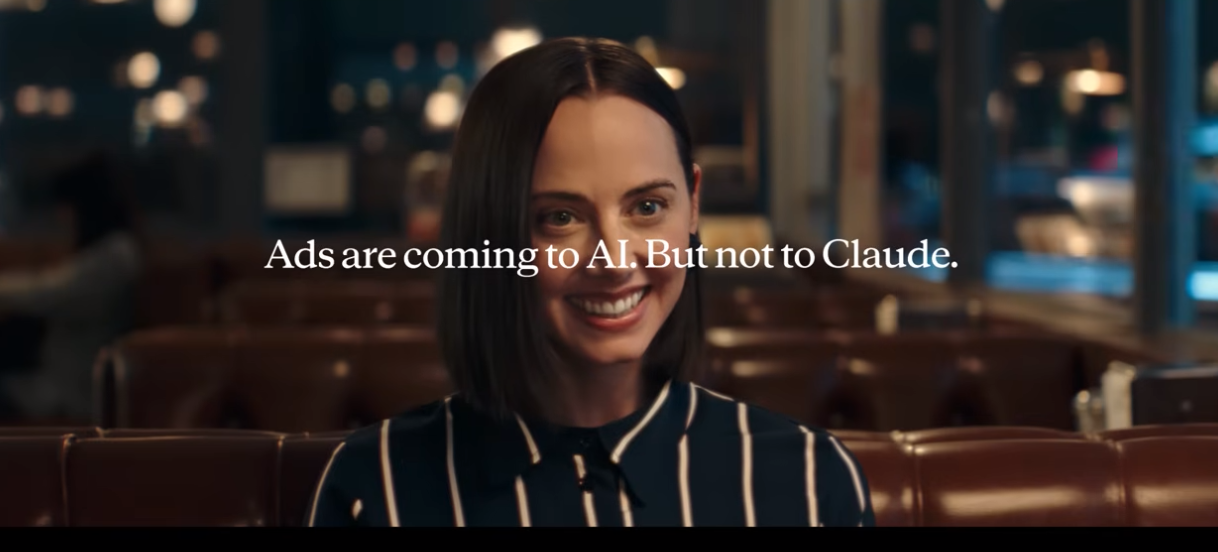
Still from an Anthropic ad. Source: Anthropic/YouTube
Anthropic has published several short video clips, each showcasing a familiar scenario in which users turn to chatbots for help: looking for workout advice, brainstorming business ideas, getting help with academic work, or figuring out how to communicate better with a family member.
The videos, posted to Anthropic’s YouTube channel and set to air during one of the biggest advertising moments of the year — the Super Bowl on February 8 — all follow the same structure. They begin with a chatbot offering advice that seems reasonable, thoughtful, and genuinely helpful only to derail abruptly into an ad that is completely tone-deaf. A personal trainer representing the AI agent suddenly starts recommending shoe insoles that add a vertical inch and help “short kings” stand tall. In another clip, the agent veers away from business advice to pitch a sketchy loan service. In yet another, a therapist talking to a user about his relationship with his mother suddenly trails off mid-sentence to serve an ad for a dating app where he can meet older women.
All the videos wrap up with the screen flashing: “Ads are coming to AI. But not to Claude,” set to Dr. Dre’s “What’s the Difference” playing in the background. The ad has uncanny parallels with Black Mirror episode Common People, which imagines a world where a character survives a life-saving experimental brain procedure only to discover that staying alive now requires a monthly subscription. As costs rise, she’s pushed onto an ad-supported tier, causing her to involuntarily blurt out ads mid-conversation that are highly inappropriate, although can theoretically follow from the context. In one instance, a student tells her that his parents are fighting and his mother wants to leave his father, and she suddenly recites an ad for a Christian family counseling website encouraging families to stay together. In another, she interrupts an intimate moment with her husband to recommend an erectile dysfunction gel. The only way to stop it is to pay for the ad-free that is very expensive. The episode exaggerates the fear Anthropic highlights: monetization intruding at moments where it is deeply inappropriate and jarring. And unlike with traditional search ads, it feels way more personal if it’s a chatbot that mirrors human speech patterns.
This is a discussion worth having. After all, chatbots are rapidly becoming a staple of everyday life. We increasingly hear stories of people growing dependent on ChatGPT, of AI companions turning into emotional stand-ins, even love interests, and of conversational bots becoming a kind of cognitive crutch, something many can no longer imagine living without.
As Denis Vyazovoy, Head of Product at AdGuard, points out:
“If advertising models start becoming more deeply integrated into AI assistants, it raises an important question of trust. Users perceive these services not as media platforms, but as helpers. Any hidden commercial motivation, even in the form of recommendations, needs to be as transparent as possible. The very fact that major AI developers are debating this issue shows that the market has yet to settle on the ethical boundaries of monetization, and right now is the perfect moment to have that conversation.”
In that sense, AI is starting to resemble the personal computer in its early days, back when it quietly but permanently reshaped how people worked and thought (bless those simpler times). So if ads in AI agents are indeed heading in the direction Anthropic warns about, alarm bells should be ringing.
Deceptive ‘doublespeak’: OpenAI’s response
Are they, though? So far, it’s hard to tell, since ads in ChatGPT are still yet to roll out widely. OpenAI CEO Sam Altman responded directly to Anthropic’s jabs in a post on X, pushing back against what he called a misleading critique.
“I guess it’s on brand for Anthropic doublespeak to use a deceptive ad to critique theoretical deceptive ads that aren’t real, but a Super Bowl ad is not where I would expect it,” Altman said.
He claimed that ChatGPT would never run ads in the intrusive way Anthropic depicts. Altman took the opportunity to contrast the two companies, calling Anthropic elitist for selling a niche, expensive product to a small, wealthy audience while highlighting ChatGPT’s democratic reach which manifests itself in free access for billions of people, with paid tiers optional and ad-free. “More Texans use ChatGPT for free than total people use Claude in the US,” he noted. Altman also framed the debate as a matter of control versus openness. While Anthropic blocks certain companies from using its coding product and positions itself as an arbiter of how AI should be used, OpenAI pitches ChatGPT as a broadly accessible tool.
Historic parallels: a well-trodden path
Cutthroat competition drives cutthroat advertising. Anthropic wouldn’t have launched such jabs and poured money into one of the most coveted ad slots just for the laughs. The company is clearly putting serious cash on the line: the 30-second Super Bowl spot reportedly costs over $8 million, and the longer pre-game ad, showing a man asking for help communicating with his mother, apparently costs a dime too.
Offering one of the most expensive AI models on the market (Altman wasn’t kidding when he said it was made for rich people), Anthropic has long been regarded as best for specialized tasks — most notably coding. But with OpenAI poaching Anthropic’s talent and cranking out new models — most recently GPT-5.3-Codex — there’s little time for sentiment. In this AI arms race, any means are justified: all is fair in love and war.
Anthropic is also clearly taking a leaf out of Apple’s playbook with its Super Bowl push. Like the iconic 1984 ad, which positioned Apple as the rebellious underdog taking on the monolithic IBM, Anthropic’s ads are designed to make a statement by mocking ChatGPT and portraying Claude as the pure unbiased choice. The impact from the Apple ad back then was immediate and measurable: reports at the time indicated that around $3.5 million worth of Macintosh computers were sold shortly after the ad aired.
The difference, of course, is that ChatGPT positions itself as the democratic alternative, while Claude remains, arguably, a high-end product for a select few. With this ad, Anthropic may be attempting to change that perception once and for all. The big question is whether this push succeeds or backfires. But Anthropic also courts a big risk: should it ever try to introduce ads of its own, it might wake up to a full-blown PR firestorm of its own making.